Indiana Country
Thursday, April 21, 2011
Tuesday, March 22, 2011
Fort Agra is a 94 acre semicircular plan, its chord lies paralled to the river and its walls are seventy feet high. Double raparts have massive circular bastions at intervals, with battleents, embrasures, machicolations and string courses. Now don't ask me what half of that means I just thought some would like to know those details that wiki was willing to share. Four gates were provided on its four sides, one Khizri gate opening on to the river.
A wooden drawbridge was used to cross the moat and reach the front gate from the mainland; inside, an inner gateway called Hathi Pol ("Elephant Gate") - guarded by two life-sized stone elephants with their riders - added another layer of security. The drawbridge, slight ascent, and 90-degree turn between the outer and inner gates make the entrance impregnable. During a siege, attackers would employ elephants to crush a fort's gates. Without a level, straight run-up to gather speed, however, something prevented by this layout, elephants are ineffective.
The Indian military still uses the northern portion of the Agra Fort, mainly the Parachute Brigade.
The site is very important in terms of architectural history. Abul Fazal recorded that five hundred buildings in the beautiful designs of Bengal and Gujarat were built in the fort. (Wiki)
A wooden drawbridge was used to cross the moat and reach the front gate from the mainland; inside, an inner gateway called Hathi Pol ("Elephant Gate") - guarded by two life-sized stone elephants with their riders - added another layer of security. The drawbridge, slight ascent, and 90-degree turn between the outer and inner gates make the entrance impregnable. During a siege, attackers would employ elephants to crush a fort's gates. Without a level, straight run-up to gather speed, however, something prevented by this layout, elephants are ineffective.
The Indian military still uses the northern portion of the Agra Fort, mainly the Parachute Brigade.
The site is very important in terms of architectural history. Abul Fazal recorded that five hundred buildings in the beautiful designs of Bengal and Gujarat were built in the fort. (Wiki)
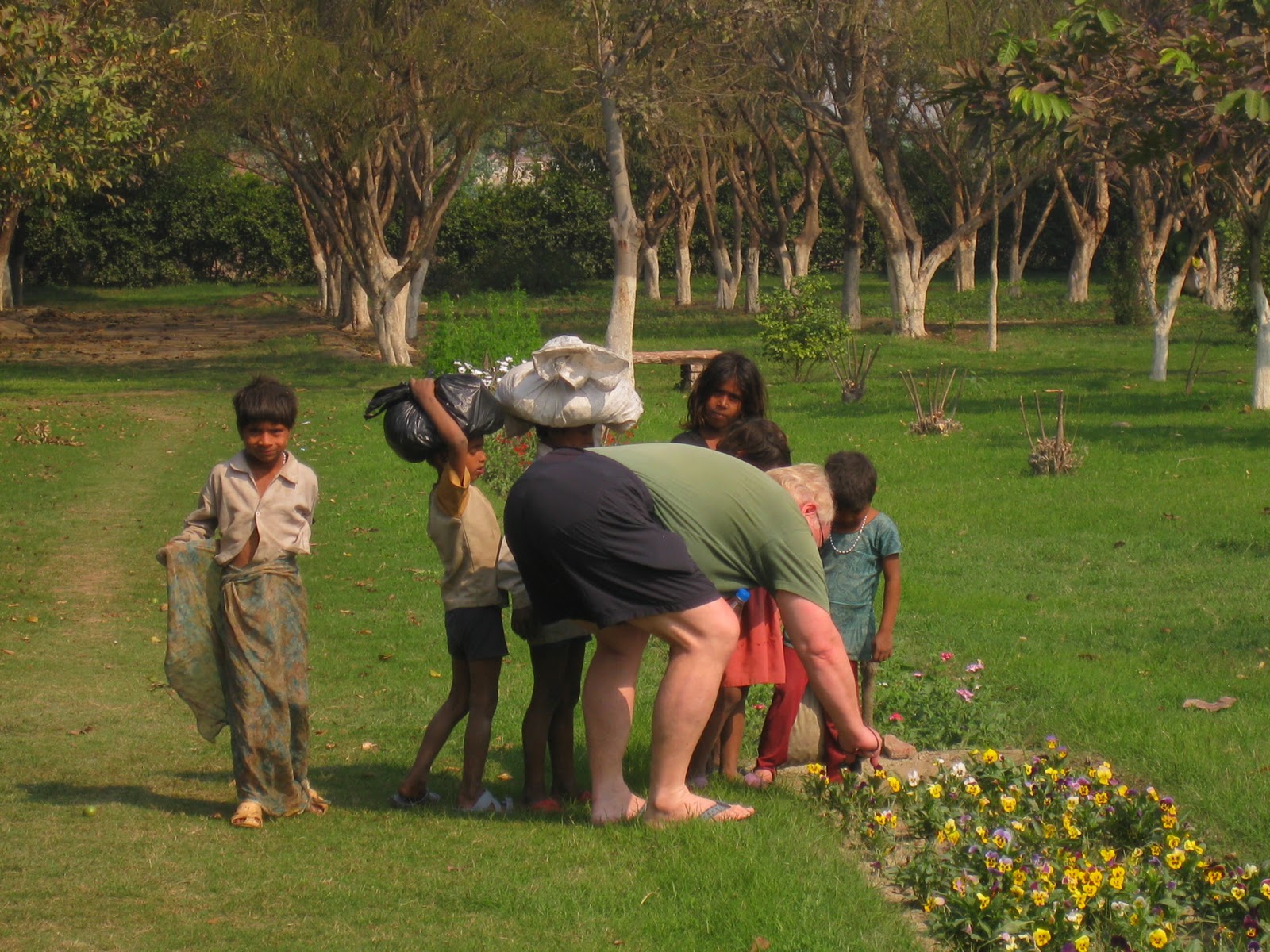
The little people of the Moonlight garden. This was great to watch.
These young people came running out of the bushes as we walked the garden paths. They asked for candy and coins...but they seemed just as interested in walking along with us. Talking to each other and occasionally rememebering to ask for candy and coin. One boy was wearing a sari of sorts and spent much time adjusting it. They seemed to want to help in any way so as to possibly make some money or maybe just pass the time of day. They noticed Bruce was taking pictures of flowers so they were pointing out some good specimens to him.
Bruce taking a close up of a flower...
The little girl to the right of Bruce is about to make a move to pull the flower out of the ground for Bruce since he sees so interested in it. Bruce told her not to pull it up...She probably thought he was strange to be taking a picture of it when you could just carry it away with you :)...they were very cute.
Moonlight Garden across the river from the Taj
Did you ever hear of the "Black Taj"? Some believe that Shahjahan wanted to make another Taj Mahal in Black Marble ? A mirror immage on the opposite bank of the river Yammuna. This was where he would be burried, his own mausoleum.
The story goes that he could not complete it due to the war of succession with his son Aurangzeb.
It was Shahjahan's son that imprissoned him in the Agra fortress. This would be where Shahjahan spent the last eight years of his life. The Taj Mahal was his view from across the river until he died and was buried beside his beloved wife Mumtaj Mahal.
There is a foundation of sorts across the river from the Taj...
Mehtab Bagh also known as the "Moonlight Garden" is a lovely first stop to view the Taj Mahal. There were two other people while we were there...we enjoyed some rare quiet moments without the crowds.
The story goes that he could not complete it due to the war of succession with his son Aurangzeb.
It was Shahjahan's son that imprissoned him in the Agra fortress. This would be where Shahjahan spent the last eight years of his life. The Taj Mahal was his view from across the river until he died and was buried beside his beloved wife Mumtaj Mahal.
There is a foundation of sorts across the river from the Taj...
Mehtab Bagh also known as the "Moonlight Garden" is a lovely first stop to view the Taj Mahal. There were two other people while we were there...we enjoyed some rare quiet moments without the crowds.
Monday, March 21, 2011
Roses from the Colonel
While on the train from Dound to Agra ( a twenty one hour journey...we luckily had our own compartment) we met a Colonel in the Indian Paratrooper Corps. He spoke English well and we enjoyed some of his thoughts on India and its many challenges. The train finally lined up with the station platform and we said our goodbyes.
Saturday, March 5, 2011
Saturday, February 5, 2011
Madhuri calling the children over for a picture...they are delighted. This is the road that runs in front of the new Cummins plant...these roads are all being vastly expanded from two lanes (...two lanes being the size of one American lane...) to six lanes. The children walking home from school often walk just off the road...you can see their heads on the left side of the picture...so they came popping out of the ditch to join the picture.
Thursday, February 3, 2011
Subscribe to:
Posts (Atom)